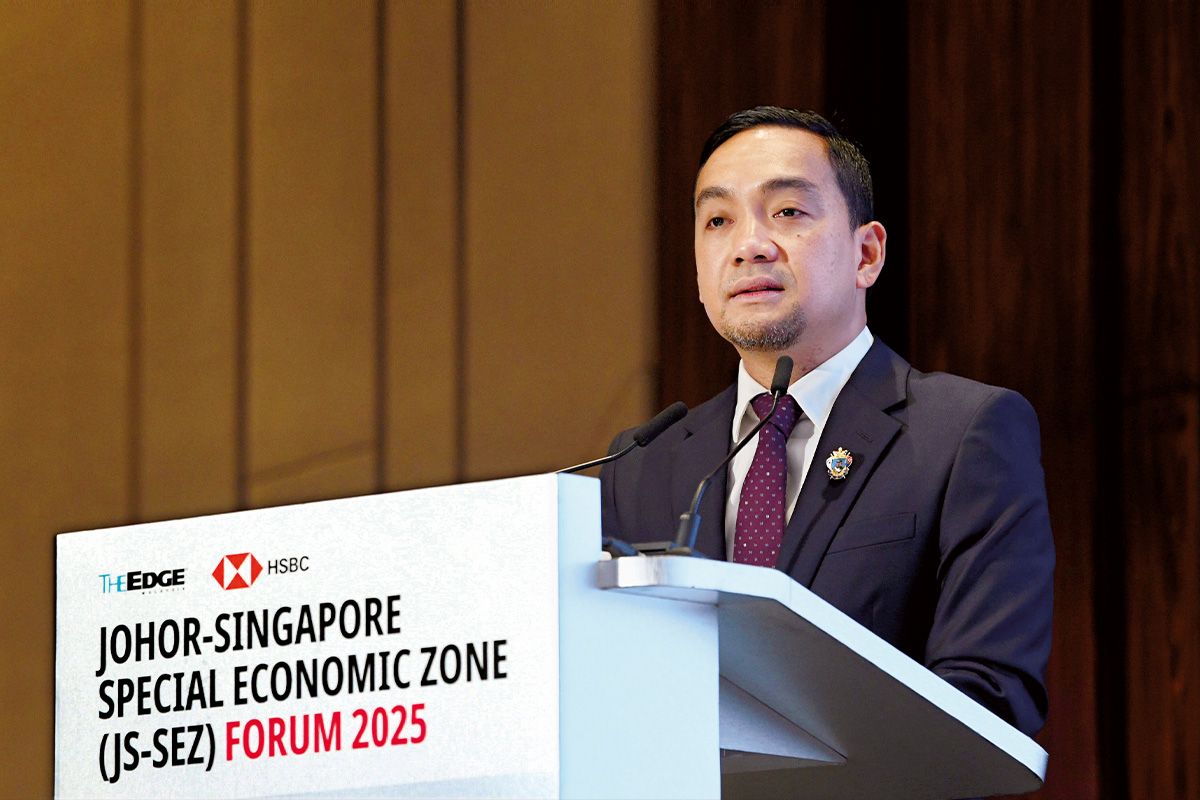
These achievements will put Johor on the map as a top investment destination. But this is more than a number. It is showing to the world that Johor can achieve substantial results if we all work together as a team.” Onn Hafiz
IN the first quarter of 2025, Johor secured RM30.1 billion in total approved investments, the highest among all states in the country. If this trend continues, Johor Menteri Besar Datuk Onn Hafiz Ghazi is confident that the state can rake in between RM60 billion and RM100 billion in approved investments by the end of the year.
This will surpass Johor’s record last year of RM48.5 billion, said Onn Hafiz during his keynote speech at The Edge-HSBC JS-SEZ Forum 2025.
“This is just the beginning. A lot more will happen in the next few years … These achievements will put Johor on the map as a top investment destination. But this is more than a number. It is showing to the world that Johor can achieve substantial results if we all work together as a team,” he said.
These achievements reflect investor confidence in Johor and also the momentum generated by the Johor-Singapore Special Economic Zone (JS-SEZ), which was first announced in late 2023. Since then, the state government has been working tirelessly to ensure that the plan is a success, said the menteri besar.
But the JS-SEZ is just part of the “overall grand scheme of things”, he said. “The Regent of Johor has decreed to me that he would like to see Johor develop to become the most developed state in Malaysia by 2030. It is a mammoth task. It is not easy. But I believe it can be done, because Johor has a lot of advantages.”
The state has vast resources and is strategically positioned next to Singapore, for instance.
“We need to see Johor as a very strong partner and a new engine of growth for the country. Through the JS-SEZ, Malaysia and Singapore can achieve wonders together,” said Onn Hafiz.
The goal is for the JS-SEZ, with its focus on 11 high-impact sectors in nine flagship areas, to generate RM260 billion in gross domestic product, 20,000 high-income jobs and 50 catalytic projects by 2030.
The JS-SEZ has three main goals: to improve the ease of doing business, enhance the ease of movement and nurture local talent. Over the years, the Johor state government has been working closely with the federal and Singapore governments to ensure these objectives are met.
For instance, the Invest Malaysia Facilitation Centre Johor (IMFC-J) was launched in February to streamline investment processes for the JS-SEZ. Located in Forest City, the IMFC-J is the first-of-its-kind integrated investment facilitation centre, led by Invest Johor, Iskandar Regional Development Authority and the Malaysian Investment Development Authority.
“It is a federal-state unified platform, designed to remove all the red tape, dissolve bottlenecks and accelerate investor timelines in the JS-SEZ,” said Onn Hafiz.
The outcomes have been encouraging. In the last four months, he said, the IMFC-J has received 439 accumulated inquiries, 57 potential investments valued at RM26.18 billion as well as six committed investments worth RM16.7 million, and processing times have been reduced from three months to between one and 35 days.
“We are the only IMFC outside the Klang Valley, and we will continue to make sure that Johor is efficient,” said Onn Hafiz.
The Forest City Special Financial Zone (SFZ), which was launched earlier this year, has also been receiving positive enquiries. Several companies, including financial institutions and logistics companies, have expressed interest in setting up operations in the SFZ.
“We are coming up with a master plan with regard to the SFZ by the end of this year, and we are targeting wealth management firms, financial services institutions, single family offices, private capital and fund managers,” he said.
Meanwhile, the Rapid Transit System (RTS), a railway shuttle link between Johor Bahru and Singapore, is the “game changer” to enable ease of movement between the two countries. The project is expected to be completed by the end of next year.
“When the RTS is ready, we will be looking at 10,000 people going in and out on an hourly basis,” Onn Hafiz said.
In the interim, the state is also upgrading the facilities and systems at the two Johor customs, immigration and quarantine (CIQ) complexes, located at Bangunan Sultan Iskandar and Kompleks Sultan Abu Bakar respectively.
“At the moment, for both CIQs, we are looking at around 300,000 people going in and out on a daily basis. [It is] one of the busiest border crossings in the world,” he said.
Within Johor, the Gemas-Johor Bahru Electrified Double-Track Project should be ready by end-2025 and is expected to reduce the travel time between Johor Bahru and Segamat to 90 minutes. The proposal for the elevated Autonomous Rapid Transit (e-ART) system, which will ease traffic congestion in Johor Bahru, will be brought to the cabinet in August.
The request for proposal for the e-ART system was advertised by the Land Public Transport Agency earlier this year.
The menteri besar also highlighted progress on highway infrastructure projects, including the expansion of the PLUS North-South Expressway from four to six lines as well as the upgrading of the Senai-Desaru Expressway, both of which are expected to be completed by 2027 or 2028.
On the issue of talent, Onn Hafiz said the state was using a demand-driven rather than supply-driven approach. The Johor Talent Development Council was formed to meet the demand of industries and is engaging with six public universities and 15 technical and vocational education and training institutions.
The state has also introduced more on-the-ground placements of students and incentives for upskilling, with the goal of producing 10,000 job-ready graduates by next year in sectors aligned with the JS-SEZ.
“We are not waiting for the master plan to be ready. We are working tirelessly now to ensure that investor demands and requests are met efficiently,” said Onn Hafiz, referring to the JS-SEZ road map to be released later this year.
While investors and businesses are enjoying the incentives and smoother processes enabled by these initiatives, the Johor state is also encouraging companies to contribute to the local communities.
A programme being developed by the state with the support of these investors is the establishment of the Sekolah Rintis Bangsa Johor (SRBJ), which is aimed at improving the education system of Johor and nurturing job-ready graduates.
There are now four SRBJs in the state and they have a heavier focus on the science, technology, engineering and mathematics (STEM) as well as English subjects.
In addition, Standard Six students will sit for the Primary School Leaving Examination (PSLE), which is a national examination in Singapore, whereas Form Five students will take the International General Certificate of Secondary Education (IGCSE), a globally recognised English language secondary school qualification, alongside the SPM.
“We want to make sure that our students can be marketed at the international level. This is just the start. We are giving our students and teachers iPads. We will have smart schools,” said Onn Hafiz.
“When we proposed the idea to all investors, [the response was positive]. We have recorded a total of RM55 million worth of contributions to develop these schools. I want to thank the contributors who ensured that the SRBJ becomes a success.”
