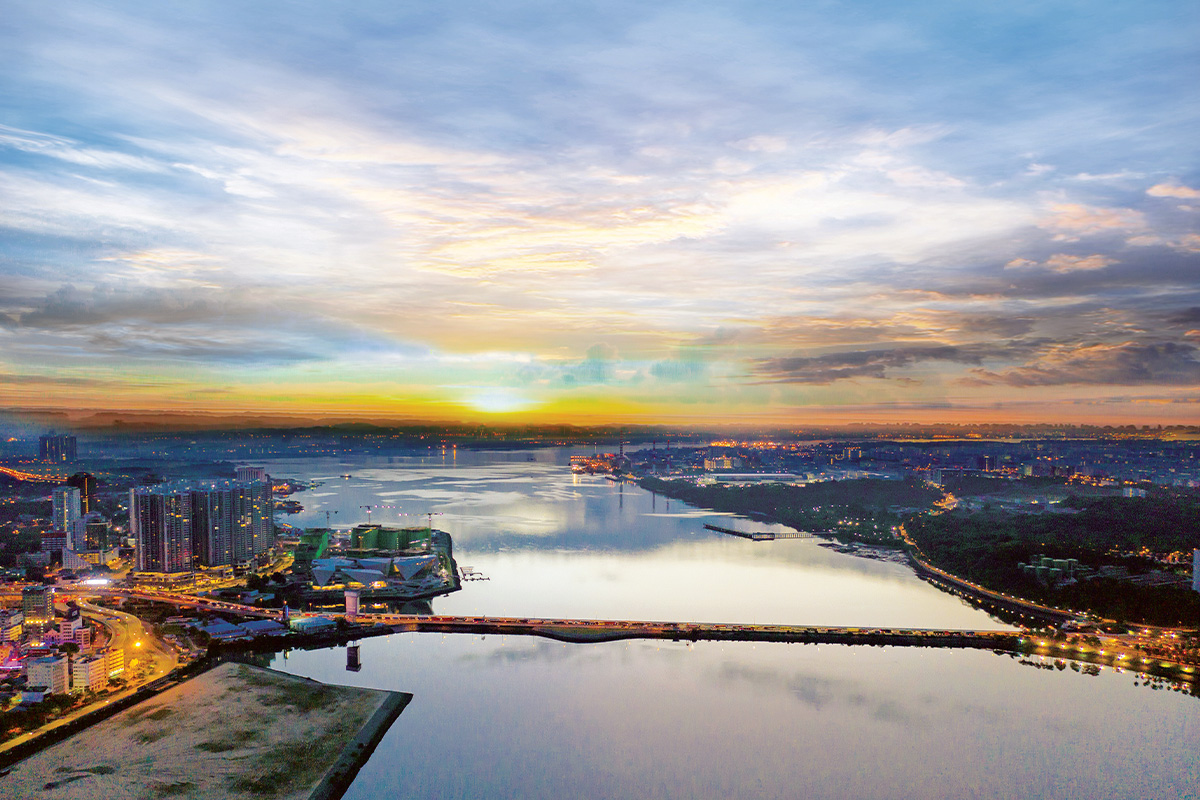
THE Johor-Singapore Special Economic Zone (JS-SEZ) has emerged as a bright spot in Malaysia’s economy over the past year and, if managed well, could become a key growth driver for the region, according to speakers at The Edge-HSBC JS-SEZ Forum 2025 held on June 23.
Optimism surrounding the JS-SEZ was evident at the forum, held at the DoubleTree by Hilton in Johor Bahru. The one-day event attracted more than 1,300 participants, both in person and online. Organised by The Edge Malaysia in collaboration with HSBC Bank, the forum was supported by IJM Corp Bhd.
Johor recorded a historic RM30.1 billion in total approved investments in the first quarter of 2025 alone, and the state is confident of reaching RM100 billion by year-end, said Johor Menteri Besar Datuk Onn Hafiz Ghazi in his keynote address.
“The JS-SEZ is just part of the overall scheme of things. We have a big vision here. The Regent of Johor has decreed to me that he would like to see Johor become the most developed state in Malaysia by 2030. It is a mammoth task, and it is not easy. But I believe it can be done because Johor has a lot of advantages,” said Onn Hafiz.
The JS-SEZ is the result of close collaboration between the governments of Johor state, Malaysia and Singapore. The project was announced in late 2023 and the formal agreement with Singapore signed in January this year.
The JS-SEZ envisions a vibrant economic hub that combines the resources and talent of Malaysia and Singapore. It is spread across nine flagship zones in Johor, covering the Johor Bahru Waterfront, Iskandar Puteri, Tanjung Pelepas, Tanjung Langsat-Kong Kong, Senai-Skudai, Kulai-Sedenak, Desaru Penawar, the Pengerang Integrated Petroleum Complex and the Forest City Special Financial Zone.
The chief minister highlighted several initiatives aimed at facilitating the movement of people and goods, improving the ease of doing business and attracting talent to the JS-SEZ. These include removing bureaucratic bottlenecks to shorten processing times and upgrading infrastructure to ease traffic congestion.
“The JS-SEZ is more than an economic corridor. It is an embodiment of our vision for Maju Johor 2030, a Johor that is modern in its infrastructure, inclusive in its growth and globally competitive in its outlook, yet deeply rooted in the values of community, sustainability and shared prosperity,” Onn Hafiz said.
“Let us continue to move forward as one team, government, businesses and civil society, shoulder-to-shoulder to ensure that Johor continues to rise not only as a preferred investment destination but as a beacon of inclusive and sustainable prosperity in Southeast Asia.”
The Rapid Transit System Link, which connects Singapore and Johor, is described as a game changer in facilitating the flow of people between the two countries. Meanwhile, the Forest City Special Financial Zone has already attracted keen interest from domestic and international businesses.
In his keynote speech, Datuk Ho Kay Tat, publisher and group CEO of The Edge Media Group, added that: “Without a doubt, the JS-SEZ is an ambitious project, and while many steps have been taken, the path ahead is still a long one. The stated goal is for the JS-SEZ to roll out 50 projects in the first five years, and scale it to 100 by the first decade, and create 20,000 high-skilled jobs.
“This is why we gave the forum the title, ‘Enabling the next leap forward’. We are curious and excited to see what will come out of the JS-SEZ, and we want to ignite discussions between different stakeholders about all the possibilities and challenges of executing this ambitious project.”
Strategic play
Other speakers at the forum emphasised the JS-SEZ’s unique advantages, including its strategic location and stable political environment amid global uncertainty. They also offered recommendations to further strengthen the zone’s success and build investor confidence.
Deputy Minister of Investment, Trade and Industry Liew Chin Tong noted that with strong cooperation between both governments, and continued development of their manufacturing and technology ecosystems, the region had the potential to build its own globally recognised brand — similar to Huawei in China or Samsung in South Korea. He stressed that such collaboration must be balanced, ensuring that neither nation outpaces the other.
“When everyone talks about Shenzhen and Hong Kong, I think the Hong Kong people are not happy. Why? Because in that model of Shenzhen and Hong Kong, Shenzhen eventually surged ahead and became a much larger economy compared to Hong Kong,” said Liew.
Datuk Lee Chun Fai, group CEO and managing director of IJM Corp Bhd, said both nations could offset the other’s shortcomings by leveraging their respective strengths, while holding each other accountable to deliver on long-term projects.
“The best part is that both governments have voiced their commitments and shown conviction. Both administrations want to make sure this happens,” Lee said.
Noting, however, that this was not Malaysia and Singapore’s first collaboration, HSBC Malaysia CEO Datuk Omar Siddiq urged the governments of both countries as well as Johor to institutionalise the partnership to secure the success of the JS-SEZ, as this would boost business confidence for long-term investment.
“Ultimately, it’s about moving up the value chain — ensuring that products and services are delivered at a level that [generates appropriate revenue and secures healthy profit margins],” said Omar.
